Programming is all about problem solving.
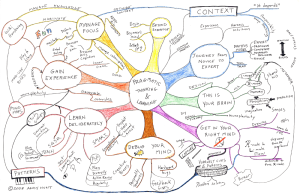
- Tip 1: Always consider the context.
- 世界上每个事物都是互联的,总是考虑上下文语境。比如你看到独立的树在地面上,但事实上,它有着两个独立的系统,一个是树叶和空气的系统,另外一个是树根和土地的系统。我们总是其中的一部分,不管你知道或者不知道。
- Tip 2: Use rules for novices, intuition for experts.
- 对入门者采用规则,对专家只有直觉
- Tip 3: Know what you don’t know.
- 知道你不知道,才能扩展你不知道
- Tip 4: Learn by watching and imitating.
- 学习只有通过观察和模仿
- Tip 5: Keep practicing in order to remain expert.
- 只有不断的练习才能保持专业
- Tip 6: Avoid formal methods if you need creativity, intuition, or inventiveness.
- 如果你需要创造力,直觉, 发明力, 避免传统正规的方法
- Tip 7: Learn the skill of learning.
- 学习学习的技能,学些的技能也是需要学习的。
- Tip 8: Capture all ideas to get more of them.
- 捕捉所有的想法是为了从他们上获得更多。
- Tip 9: Learn by synthesis as well as by analysis.
- 学习是通过合成和分析获得的。
- Tip 10: Strive for good design; it really works better.
- Tip 11: Rewire your brain with belief and constant practice.
- Tip 12: Add sensory experience to engage more of your brain.
- Tip 13: Lead with R-mode; follow with L-mode.
- Tip 14: Use metaphor as the meeting place between L-mode and R-mode.
- Tip 15: Cultivate humor to build stronger metaphors.
- Tip 16: Step away from the keyboard to solve hard problems.
- Tip 17: Change your viewpoint to solve the problem.
- Tip 18: Watch the outliers: “rarely” doesn’t mean “never.”
- Tip 19: Be comfortable with uncertainty.
- Tip 20: Trust ink over memory; every mental read is a write.
- Tip 21: Hedge your bets with diversity.
- Tip 22: Allow for different bugs in different people.
- Tip 23: Act like you’ve evolved: breath, don’t hiss.
- Tip 24: Trust intuition, but verify.
- Tip 25: Create SMART objectives to reach your goals.
- Tip 26: Plan your investment in learning deliberately.
- Tip 27: Discover how you learn best.
- Tip 28: Form study groups to learn and teach.
- Tip 29: Read deliberately.
- Tip 30: Take notes with both R-mode and L-mode.
- Tip 31: Write on: documenting is more important than documentation.
- Tip 32: See it. Do it. Teach it.
- Tip 33: Play more in order to learn more.
- Tip 34: Learn from similarities; unlearn from differences.
- Tip 35: Explore, Invent, and apply in your environment—safely.
- Tip 36: See without judging and then act.
- Tip 37: Give yourself permission to fail; it’s the path to success.
- Tip 38: Groove your mind for success.
- Tip 39: Learn to pay attention.
- Tip 40: Make thinking time.
- Tip 41: Use a wiki to manage information and knowledge.
- Tip 42: Establish rules of engagement to manage interruptions.
- Tip 43: Send less email, and you’ll receive less email.
- Tip 44: Choose your own tempo for an email conversation.
- Tip 45: Mask interrupts to maintain focus.
- Tip 46: Use multiple monitors to avoid context switching.
- Tip 47: Optimize your personal workflow to maximize context.
- Tip 48: Grab the wheel. You can’t steer on autopilot.
 Qunfei@Data, ML and AI Architecture
Leave a comment